
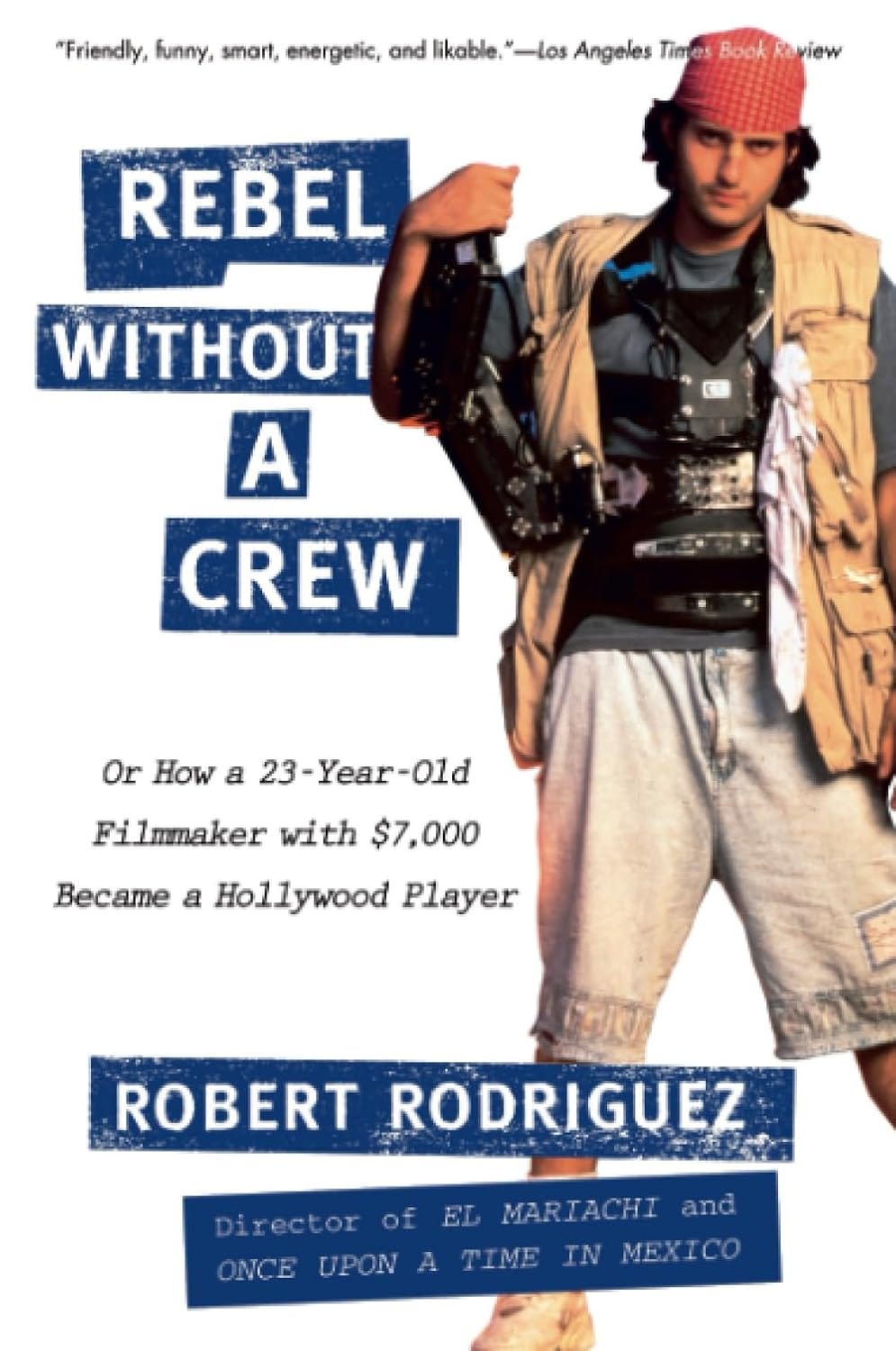
I'm really enjoying Rebel without a Crew. It's the diary entries of Robert Rodriguez as he's making his first feature film El Mariachi. The book isn't on Kindle so I'm reading it on paperback which feels appropriate to the subject matter.
I'm reflecting on how powerful it is to intentionally build up a series of studies in order to learn the skills to realize an ambitious creative vision. All artists do this, but I haven't seen the process documented so clearly. After dozens of "home videos", even El Mariachi is just a plan to make a cheap film in Mexico while on summer break to learn how to go from shorts to feature-length, though it ends up taking off.
It's also an interesting portrait of a transitional time in the technology of film-making. He's enabled by VCRs, which he gets when he's 12. With 2 VCRs he's able to edit home videos by playing one tape while recording into another. The VCR only pauses for 5 minutes before auto-shutoff so he needs to find the next cut within that time limit, which teaches him to pre-plan his shots. Later, when he's 24 and splicing film in Hollywood, he has a discussion with another editor about how computers are going to be so much better for this (but the tech isn't there yet).
So it's a transitional time, and I'm not sure that our latest tech is better for the development of creative skills. You don't have a 5 minute time limit, but now the constraints don't channel your focus on mastering the fundamentals.
It makes me reflect on my time learning programming with HyperCard on an original Mac, which feels like the VCR-era for programming. I would check out a book about programming from the library and had to type in the code myself (no internet to copy-paste from). The screen is black and white, low-resolution, so you had to focus on dynamics, not graphics, to make eg an engaging game.