
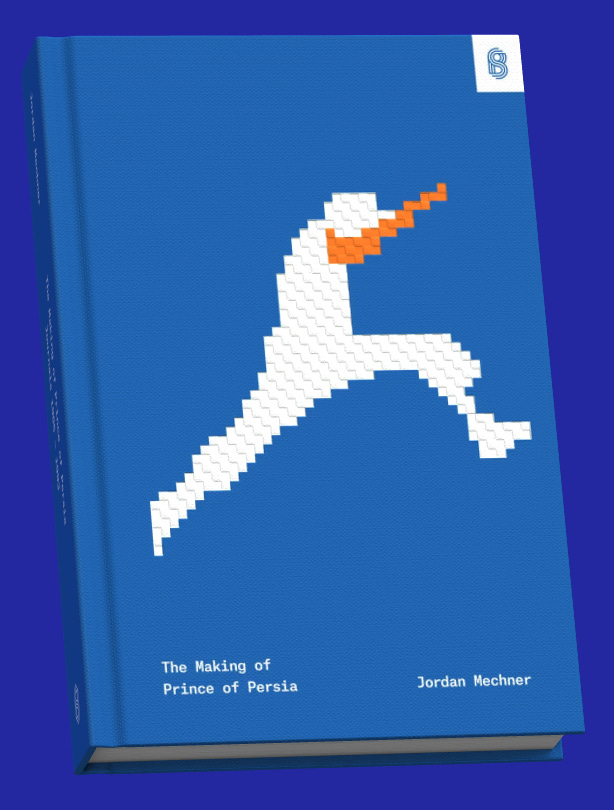
Looking for more diaries documenting creative projects, I read this book after Rebel without a Crew. It’s not quite as exciting as Rebel because the stakes aren’t as high. Rodriguez was really starting with nothing, no money or social connections, so it’s exhilarating to watch him go. Mechner at this point in his life is already coasting. Still good documentation and the sketches are cool, but start with Rebel.
The diary entries faithfully capture both the doubts and excitement of the author as he’s creating his project, which is useful to see for any creative person who also struggles with the highs and lows of long projects — probably most people, myself included.
Reflecting on the time period, I think about the “physics” of the creative universe and how they’ve changed. By physics I mean the economic and technological constraints of a given time period.
Although Mechner is building his game largely on his own, it requires recruiting a software distribution company to back the project and a team of people to do the marketing and ports to other systems. We also follow his film script projects as they are passed between agents and producers in the Hollywood system but unlike Prince of Persia never amass quite enough social excitement to get off the ground.
Like Rebel, the technical constraints force a certain kind of creativity. Mechner spends a lot of time working on internal tools for drawing sprites and levels, explaining that these are absolutely essential to being able to create the game. He also films actors running, crouching, jumping, pulling themselves up onto a ledge. He then manually rotoscopes the footage to create the pixely animations of the game. Along the way he encounters annoying technical issues with the toolchain of digitizing his footage.
Mechner is forced to expend creative energy over long periods of time simply to overcome technical issues. In doing so he’s forced to sit with his creative work longer. It’s frustrating when the footage doesn’t work out due to a glitch with the toolchain, but then he has to do another take. He invents tools and processes to streamline manual labor, but this forces him to reflect on which parts of that labor are essential to achieving the impact he’s aiming for with the work.
I wonder: if the physics of the creative universe at a given time require that a project recruit more time, attention, and excitement in order to be realized, does that result in stronger works? Take film, animations, or videogames for example. Before the technology is ready you can’t create anything in the medium at all. Then it’s so primitive that the only things you can create are curiosities. But then are there “sweet spots” where the limitations forge gems? Once the technology and economics pass beyond these spots, does the world produce fewer gems or does it just seem that way because more banal stuff is also now produced? I think it’s the latter, but that gems always require a chain reaction of attention — like making tools to rotoscope filmed actors to produce game animations — and these chain reactions can be sparked by technological or economic constraints.